The Waiting Room
Notes on Westvleteren, the beer that would rather you didn't want it

The road from Poperinge runs flat through hop country. In late summer the bines climb four meters (thirteen feet) up their wires, and for stretches you drive between green walls with only a strip of sky above the windshield.
This is the far western edge of Belgium, about ten kilometers (six miles) from France and twenty from Ypres. It is beautiful farm country, but the landscape carries its history everywhere. Every few fields there seems to be another low white wall surrounding rows of headstones.
At the end of one of these roads sits a brick abbey behind a screen of beech trees. Behind the abbey is a brewery whose output the abbey's own account puts at about 6,000 hectoliters a year, roughly 5,100 US barrels, spread across 42 brewing days. Bloomberg, reporting in December 2025, put it higher: just over 7,500 hectoliters, about 6,400 barrels, brewed on 57 days.
Either way the number is trivial.
A mid-sized American craft brewery can make more. Chimay, the largest of the Belgian Trappist houses, makes somewhere between 120,000 and 170,000 hectoliters depending on whose figure you take, roughly 102,000 to 145,000 barrels. Westmalle makes about 120,000, some 102,000 barrels. The Abbey of Saint Sixtus at Westvleteren makes a fraction of either. It does not advertise, sells to no conventional distributor in Belgium and, for most of the last century, didn’t even bother putting labels on its bottles.
It also makes a beer that a significant part of the drinking world has at one point or another declared the best beer on earth.
The monks have never seemed particularly impressed by this distinction.
Their explanation has remained essentially the same for years: We are not brewers. We are monks. We brew beer to be able to afford being monks.
The abbey’s own version is even simpler.
We brew to live. We do not live to brew.
I've been interested in Belgian beer for a long time, and I've watched Westvleteren go from something beer obsessives whispered about to a full-blown pilgrimage.
There are two predictable ways to write about it.
One turns the place into mythology. Silent monks. Ancient recipes. The Holy Grail of beer.
The other tries to puncture all of that. It’s good beer, not magic. You’re paying for scarcity and a story.
Neither gets Westvleteren quite right.
Because the interesting thing about this place isn’t really whether Westvleteren 12 deserves to be called the best beer in the world. It’s what happens when a small community decides exactly how much it needs and then refuses, for decades, to make more just because everyone else wants it.
How it came to be this way
Start with the numbers.
Monks arrived here in the early nineteenth century, when a hermit named Jan-Baptist Victoor was joined by brothers from Mont-des-Cats, across what is now the French border. The community received its brewing license in 1839, signed by Leopold I, and the first documented brew followed that June.
For roughly a century, it operated much like other abbey breweries. Beer was part of the economy of the monastery, alongside the other things a religious community produced to feed itself, support itself and receive guests.
Then came a decision and a refusal that shaped nearly everything that followed.
The first was commercial.
Beginning in 1946, the monks licensed the Saint Sixtus name to a brewery in nearby Watou. That brewery made and sold beer under the name for decades. When the arrangement ended in 1992, the Watou brewery continued under the name St. Bernardus.
The two breweries then took very different paths.
St. Bernardus built a conventional commercial brewery. Its beer traveled.
Westvleteren stayed behind the abbey walls.
The second was a refusal, and it has no date on it, because it is not a decision so much as a standing one. The abbey has never added tanks. When the brewery reached its ceiling of roughly 4,750 hectoliters around the turn of the century, about 4,050 US barrels, that was not a limit anybody imposed from outside; it was simply the point at which a community that will not expand stops expanding.
Everything that follows in this story follows from that refusal the way a conclusion follows from a premise. If you will not make more, and demand rises without limit, then everything you build afterwards is a rationing machine.
For years, that meant a telephone.
The bierlijn, or beer line, opened on assigned days. If you managed to get through, you received a pickup time and registered the license plate of the vehicle coming to collect the beer.
Getting through became something of a sport.
People used autodialers. Belgian friends kept the number saved in their phones. The line rang so relentlessly that, for a contemplative community built around quiet, the solution had become its own problem.
So in 2019 the telephone disappeared and Westvleteren moved online.
That did not make buying the beer particularly easy.
The webshop opens at designated times. Buyers enter a digital waiting room and can sit there for an hour or more. Reach the front and you have a short window to place an order. Purchases are limited, orders are tied to the buyer and vehicle, and the beer is collected at the abbey.
No shipping, unless you live in Belgium.
No distributor dropping a case at your local bottle shop.
You go to Westvleteren.
The prices are almost comical when compared with the secondary market. A crate of 24 Blond has sold for around 48 euros, the 8 for 51 and the 12 for roughly 58.
In dollars, about 56, 59 and 67.
Call it €2.40, roughly $2.80, a bottle for Westvleteren 12.
That same bottle can appear in specialty shops hundreds of miles away for many times that amount. Bars have charged prices for a single pour that approach what the abbey charges for an entire crate.
And the monks could fix that tomorrow.
They could double the price. Triple it, probably. They could increase production. They could sign distribution agreements. They could build a visitor center, sell branded glassware, open a tasting room and turn the place into one of the most profitable beer destinations in Europe.
They don’t.
Why they will not make more
The obvious business-school answer to excess demand is to raise the price or increase supply.
Westvleteren does neither.
Part of the reason is structural. The Authentic Trappist Product rules require the beer to be brewed within the monastery, under the supervision of the monastic community, with revenue directed toward the monastery and charitable purposes rather than private profit.
But the thinking goes deeper than a certification mark.
Benedictine tradition has long treated commerce cautiously. The monastery needs money to exist, but making money is not supposed to become the reason the monastery exists.
Westvleteren has carried that idea into an economy that does not know what to do with it.
The predictable result is resale.
Buy beer cheaply at the abbey. Sell it elsewhere for five, ten or twenty times the price.
The monks hate this.
Buyers have long been asked to agree not to resell their beer, but bottles still turn up in Belgian and Dutch shops, online stores and bars around the world.
In 2023 the abbey tried something different. It began supplying a limited number of vetted retailers in the Netherlands, with the expectation that they sell the beer at controlled prices.
For Westvleteren, this was practically a market intervention.
The idea was simple enough: if people were going to resell the beer anyway, legitimate bottles sold at reasonable prices might undercut some of the profiteering.
But there is another problem that no pricing system can solve.
There are fewer monks.
By late 2025, only a handful were involved in running the brewery day to day, with even fewer working there full time and others helping during bottling.
That matters because Westvleteren isn’t simply a brewery located at a monastery.
The monastery is the reason the brewery exists.
If the monastic community disappears, you cannot solve the problem by hiring another shift.
The three beers
There are three Westvleteren beers.
All are unfiltered, unpasteurized and refermented in the bottle. For most of their modern history you identified them by the color of the crown cap because, until 2022, the bottles had no conventional labels.
The green cap is Westvleteren Blond, 5.8 percent. Dry, peppery, slightly grassy. It is the sort of beer that makes considerably more sense after you’ve spent a few days drinking in Belgium.
The blue cap is Westvleteren 8, at 8 percent. Darker, with caramel and stone fruit, and the one I would make an argument for as the best beer the abbey actually brews.
Almost nobody travels here for it.
They come for the yellow cap.
Westvleteren 12.
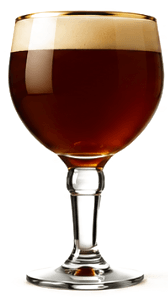 Westvleteren 12FigRaisinDark ChocolateCaramel
At 10.2 percent, it pours dark garnet-brown beneath a dense tan head. Fig, dates, banana bread and rum-soaked raisin show up immediately, with leather and something faintly savory underneath.
There are plenty of Belgian dark strong ales working in roughly the same territory. What Westvleteren 12 does unusually well is carry all of that flavor without feeling as heavy as it should.
The candi sugar helps thin the body. Carbonation stays lively. The finish is warm but surprisingly dry.
A 10.2 percent beer shouldn’t disappear this easily.
Age it for three or four years and it changes. Some of the brighter fruit fades and the beer moves toward port, cocoa and old wood.
So, is it the best beer in the world?
I don’t know what that means anymore.
RateBeer users helped ignite the Westvleteren phenomenon when they put the 12 at the top of their rankings. The reputation spread from there until drinking one became a kind of credential among serious beer people.
It is unquestionably an exceptional beer.
It is also not alone.
St. Bernardus Abt 12 sits remarkably close to it stylistically, which makes sense given the history of the two breweries. You can walk into a Belgian shop and buy St. Bernardus for a few euros without registering a license plate, entering a waiting room or driving into rural West Flanders.
St. Bernardus Abt 12Dark FruitCaramelMaltChocolatePut the two side by side and the conversation gets considerably more interesting.
Some experienced drinkers prefer Westvleteren.
Some prefer St. Bernardus.
And some discover that the gap between a legendary beer and a readily available one is much smaller when nobody tells them which glass is which.
That doesn’t make Westvleteren a fraud.
It makes the trip part of the beer.
You can’t entirely separate the taste of Westvleteren 12 from everything required to get one. The waiting room. The drive through the hop fields. The abbey behind the trees. The crate in the back of the car.
Normally, scarcity makes me suspicious. Plenty of companies manufacture it because telling people they can’t have something is a remarkably effective way to make them want it.
Westvleteren is different.
The monks aren’t limiting production so they can charge more.
They’re limiting production because they don’t want to make more.
That distinction is the whole story.
There is one easier way to drink the beer.
Across the road from the abbey is In de Vrede, “In Peace,” a café that can be considerably less peaceful on a summer weekend.
There are cyclists, tour groups, Belgian families and beer tourists working their way through tasting flights.
You can sit down and order Westvleteren there. Sometimes you can buy a small quantity to take home.
But you still have to come here.
That feels important.
From the terrace, the abbey is only about a hundred meters, some 330 feet, away behind the trees. You cannot tour the brewery. You cannot wander through the monastery. There isn’t a VIP package that gets you inside.
The monks are over there.
You are over here.
For a place responsible for one of the most famous beers in the world, remarkably little has been arranged for your benefit.
And maybe that is why Westvleteren remains interesting after all the rankings, resale prices and mythology are stripped away.
Nearly everything surrounding modern beer encourages expansion. Make more. Open another taproom. Add distribution. Build the brand. Sell the lifestyle.
Westvleteren has spent decades answering that pressure with some version of no, thank you.
The irony is that this has created exactly the sort of authenticity that marketing departments spend fortunes trying to manufacture.
A beer with almost no branding became one of the strongest brands in beer.
A brewery that refused to chase demand created extraordinary demand.
A monastery that wanted enough money to continue being a monastery accidentally produced a luxury object.
And the one part nobody can successfully reproduce is the reason the beer exists in the first place.
Bring a bottle home if you can.
Put it somewhere cool. Leave it alone for a couple of years.
Then open it with someone who cares about beer.
The beer will probably be excellent.
But I suspect you’ll spend just as much time telling them how you got it.