Nobody Called Westvleteren 12 a Quadrupel
The word is centuries old. Its use for beer dates to 1991.

Go into any decent bottle shop and there will probably be a shelf card somewhere that says QUADS. Underneath it: Rochefort 10, St. Bernardus Abt 12, Chimay Blue, maybe Westvleteren 12 if the shop has a friend in Belgium.
Now pick up the bottles.
Rochefort 10 says Rochefort 10. Chimay says Blue. St. Bernardus says Abt. Westvleteren, for most of its life, said almost nothing at all because the beer was identified by the color of its crown cap.
Not one of those breweries calls its beer a quadrupel.
The word on the shelf card belongs to the shop, not to the beer.
That distinction turns out to matter.
The Beer Judge Certification Program, probably the closest thing the English-speaking beer world has to a rulebook, puts these beers in category 26D: Belgian Dark Strong Ale. Its own guidelines make an interesting qualification. The style is also known as Belgian Quad, the BJCP says, mainly outside Belgium, while Quadrupel is the name of a specific beer.
That specific beer is Dutch.
The Quadrupel That Actually Started It
La Trappe Quadrupel comes from the Koningshoeven brewery at Berkel-Enschot in the Netherlands.
Because the history of the name gets repeated so often, I decided to ask the brewery directly.
La Trappe replied.
According to the brewery, Quadrupel was first brewed in 1991. The name was chosen by the monks of Koningshoeven because, as the brewery put it, omdat dit de biersoort het best omschrijft: because it best describes the type of beer.
It also followed naturally from the names already in the range.
Dubbel.
Tripel.
Then Quadrupel.
That puts a surprisingly recent date on a word that now sounds like it has always belonged to Belgian monastic brewing.
By 1991, the Berlin Wall had fallen, CDs were commonplace, and Westvleteren 12 had already existed for roughly half a century.
And La Trappe wasn't Belgian.
It was Dutch.
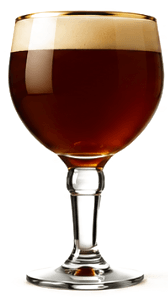 La Trappe QuadrupelCaramelBananaAlmondVanilla
But the word quadrupel itself is much older than the beer.
Before It Meant Beer
I searched the Dutch national newspaper archive, Delpher, for quadrupel.
The earliest results have nothing to do with brewing.
They are mostly about diplomacy.
The Quadrupel-Alliantie appears repeatedly across a century and a half of Dutch newspapers: the alliance of 1718, the alliance of 1834 over the Iberian succession, and later political coalitions described with the same language.
A Middelburg newspaper from April 1763 provides an especially useful example. In a list of European treaties, it refers to the Tripel-Alliantie of The Hague in 1717, followed by the Quadrupel-Alliantie of London in 1718. The same linguistic progression appeared in Dutch print 228 years before monks at Koningshoeven applied it to beer.
The word turns up in plenty of other places.
In 1767, a papal nuncio paid each of his physicians a quadrupel, referring to a Spanish gold coin. Amsterdam and Leiden exchange-rate columns later quoted the quadrupel's value alongside other currencies.
By the nineteenth and twentieth centuries, the word had been attached to quadruple-expansion marine engines, quadruple-plated silverware, four-man sculling boats and, in 1960, a performance involving a Bach dubbel-, tripel- en quadrupel-fuga.
The monks at Koningshoeven therefore didn't invent quadrupel.
They took an ordinary Dutch word meaning fourfold and applied it to a beer.
That is the important distinction.
The word is centuries old.
The beer meaning isn't.
I Read All 147 Results
There were 147 results for quadrupel in the archive.
I went through them in date order.
From 1745 onward, the word moves through treaties, coins, marine engines, silverware, telegraph equipment, mathematics, music and rowing.
A mathematical paper from 1911 discusses een quadrupel involutie in het platte vlak en een daarmede verbonden tripel involutie. In 1960 it appears in connection with Bach's unfinished quadruple fugue. In other years it's attached to boats and machinery.
The last non-beer citation I found before the change comes from March 1992, when a composer described a quadrupel canon in an opera he was writing.
Then beer finally appears.
On September 16, 1994, the Dutch daily Trouw ran an article titled Trappist nu uit gewoon flesje.
Discussing the stronger beers from Koningshoeven, the article mentions:
Quadrupel maar liefst 10%.
Trouw, 16 September 1994
Quadrupel, no less than 10 percent.
In the 147 Delpher results I reviewed, that's the first time the word refers to beer.
That doesn't prove nobody used quadrupel for beer before 1994. Delpher isn't a complete record of every Dutch publication, and its searchable text is produced from scanned newspapers.
But it does show something useful.
Across a substantial body of Dutch print spanning roughly two and a half centuries, quadrupel repeatedly meant things other than beer. Then, in the 1990s, the beer meaning appears.
The brewery dates the beer itself to 1991.
Then the Brewery and the Archive Disagreed
One part of the brewery's account didn't survive the newspaper search quite so neatly.
Most histories of La Trappe Quadrupel describe it as originally being a seasonal beer.
I asked the brewery about that too.
Their answer was that Quadrupel moved to year-round production vrijwel direct: almost immediately.
Initially, I accepted that. A brewery ought to know the history of its own beer, and I revised this article accordingly.
Then I found a newspaper from 1994.
On November 17 of that year, the Algemeen Dagblad ran a page titled Een donkere Trappist en een Witte Kerst, written by Rob van Santen from Berkel-Enschot.
At the time, the brewery was still called De Schaapskooi, the sheepfold.
The article describes the brewery as counting the success of the seizoensbier Quadrupel among the highlights of its 110th anniversary year.
Het seizoensbier.
The seasonal beer.
The photograph caption reinforces the description, calling Quadrupel een echt feestbier, a real celebration beer, brewed for the occasion of the brewery's 110th anniversary.
Six months later, in May 1995, the same newspaper referred to de Quadrupel die in de herfst wordt gebrouwen.
The Quadrupel that is brewed in autumn.
That is contemporary evidence from only a few years after the beer's introduction, and it doesn't fit comfortably with the brewery's recollection today that year-round production began almost immediately.
Both accounts may contain part of the truth.
A beer introduced as a seasonal could have moved into regular production relatively quickly. Thirty-five years later, exactly when that transition happened may simply be difficult to reconstruct.
But I can't reconcile the two accounts from the evidence I have.
The brewery says one thing today.
Newspapers published near the time say another.
In this case, I give considerable weight to the contemporary reports.
There's a useful lesson in that. A first-party source isn't automatically the best source on its own distant past.
I had removed the word seasonal from this article based on the brewery's answer.
Then the archive made me put it back.
Stan Hieronymus, author of Brew Like a Monk, once gave quadrupel an appropriately untidy description:
Not quite a style.
The history suggests he had a point.
The Beers Came Before the Category
Westvleteren 12 was introduced around 1940.
Rochefort's strongest beer followed in the late 1940s and early 1950s.
Chimay's strong dark beer arrived just after the war.
Today, all three are routinely called quadrupels.
But they existed decades before quadrupel meant anything about beer.
Westvleteren 12 had already been around for roughly fifty years when La Trappe first brewed Quadrupel.
Calling Westvleteren 12 a quadrupel can be useful today. It tells a modern drinker roughly where the beer sits stylistically.
What it can't tell us is what the monks thought they were making in 1940.
The BJCP is fairly careful about this.
Its guidelines acknowledge that many examples are simply known by strength or color designations. It also notes that terms such as Grand Cru generally say more about perceived quality than about a defined style.
There is another common misunderstanding hiding in those names.
The numbers on Westvleteren bottles aren't alcohol percentages.
Westvleteren 12 is 10.2 percent ABV. Westvleteren 8 happens to be 8 percent, which makes the naming system look more straightforward than it is.
The numbers come from an older way of indicating beer strength.
Reading them as modern ABV labels is another case of applying a newer system to an older beer.
Tripel Has Its Own Problem
If quadrupel has a relatively clear starting point, the history of tripel is less settled.
The Oxford Companion to Beer gives one version.
According to that account, the first commercial tripel was Hendrik Verlinden's Witkap Pater, brewed at De Drie Linden in Brasschaat in 1932 and trademarked as Witkap Pater = Trappistenbier. The Companion notes that this was the first legal use of the word Trappist as a trademark.
Westmalle then introduced a strong pale beer called Superbier in 1934. Brother Thomas later reworked the beer and renamed it Tripel in 1956.
Other commonly repeated histories tell it differently.
In those versions, Westmalle brewed a 9.5 percent strong pale ale in 1934, called it Tripel from the beginning, and established the modern use of the name.
Those accounts are twenty-two years apart and credit different people.
I can't resolve that conflict from the available secondary sources, so I won't pick one simply because it produces a cleaner story.
What both versions establish is enough for the larger point.
As a commercial beer designation, tripel dates to the twentieth century, and the Westmalle recipe now treated as a benchmark was established in 1956.
It isn't a medieval beer category.
Dubbel Is Older, But Not Ancient in the Way We Imagine
Dubbel has a longer history.
Westmalle brewed a strong brown beer in 1856. The recipe from which the modern beer descends dates to 1926 and was reworked by Hendrik Verlinden, the same brewer who appears in the competing histories of tripel.
The name became more widespread commercially after the Second World War as abbey beers grew in popularity and other breweries adopted similar terminology.
Westmalle's own explanation is refreshingly straightforward.
The name refers to doubling the ingredients used in the lighter beer the monks brewed for themselves.
There is also the familiar story that dubbel and tripel descend from medieval barrels marked X, XX and XXX to indicate strength.
It is a good story.
It may even be true.
But the Oxford Companion to Beer presents it as a theory, which is how it should be treated. I haven't found a contemporary document that proves it.
Beer Styles Are Filing Systems
None of this makes quadrupel useless.
When a bottle shop puts Rochefort 10 beside St. Bernardus Abt 12 under a sign marked QUADS, the sign tells you something useful.
You can expect strong, dark, malt-driven beers with considerable alcohol and broadly related flavor profiles.
The BJCP range of 8 to 12 percent ABV is useful information.
The problem comes when a modern classification gets mistaken for the historical identity of the beer.
Beer styles feel older and more fixed than they often are.
In practice, many of the categories English-speaking drinkers now take for granted were organized and popularized relatively recently.
Michael Jackson's The World Guide to Beer helped establish the framework in 1977. The BJCP, founded in the 1980s, later formalized styles into categories that could be used for judging.
And quadrupel doesn't appear in Jackson's 1977 book.
Not as a style.
Not as an aside.
I searched the full text of the 1977 Running Press edition for it and found nothing.
There are limitations to that search. The Internet Archive scan has some text loss near the binding, and OCR isn't infallible.
Still, its absence makes historical sense.
In 1977, La Trappe Quadrupel was fourteen years away.
Jackson did visit the brewery that would eventually create it.
On page 137, he writes that the Trappist fathers at Our Lady of Koningshoven, near Tilburg, operated "the only abbey brewery in The Netherlands," then known as the Schaapskooi.
He describes its output at the time as a Pilsener-type beer and a top-fermented, bottle-conditioned Trappist beer of about 6.5 percent ABV.
That's it.
No Quadrupel.
More surprisingly, no Dubbel or Tripel range waiting to culminate in one.
The product ladder that would eventually lead to Quadrupel hadn't been built yet.
Jackson also records another detail that doesn't fit neatly with the image the word quadrupel later acquired.
The brewery was then operated in conjunction with Artois, the Belgian industrial brewer whose corporate lineage eventually became part of AB InBev.
The brewery that would later give the beer world one of its most monastic-sounding style names wasn't isolated from commercial brewing at all.
So What Is Westvleteren 12?
Belgian breweries historically named beers in all sorts of ways.
By color.
By strength.
After an abbot.
After a patron saint.
Sometimes barely at all.
They weren't working from the modern style classifications we use to organize those beers today.
Neither were the Dutch monks who introduced La Trappe Quadrupel.
There is no indication they were trying to establish a new international beer category or claim some ancient tradition.
They had a Dubbel.
They had a Tripel.
They made something stronger and used the ordinary Dutch word that came next.
Quadrupel.
Fourfold.
The name worked.
Other people eventually found it useful for describing similar beers, including beers that had existed for decades before La Trappe Quadrupel was brewed.
That's how a product name became a category.
And it's why, if you want to describe Westvleteren 12 historically rather than stylistically, the most accurate name is still the one the monks themselves use.
Westvleteren 12.
Westvleteren 12FigRaisinDark ChocolateCaramel